Thomas James and the Erie Canal
1821: Memoir, Map
Overview
In June 1821, Thomas James (1804-1891) escaped enslavement near Canajoharie, New York. The Erie Canal was just being surveyed, and he followed its route west all the way to the Niagara River at Youngstown. There he crossed into Canada by ferry with help from Olaf Hathaway, a local man well known for his compassion. When James returned to the U.S., he worked on the Erie Canal in Rochester and also for a Youngstown-area farmer. James, learned to read and write, became an abolitionist, and was ordained in 1833 as a minister of the African Methodist Episcopal Zion Church. He served several churches in New York and New England. As pastor of the church in New Bedford, Massachusetts, he ordained Frederick Douglass, newly escaped from slavery in Maryland, as a preacher.
Memoir:
Here is the story of Thomas James’ escape in his own words.
“My master had worked me hard, and at last undertook to whip me. This led me to seek escape from slavery. I arose in the night, and taking the then newly staked line of the Erie canal for my route, traveled along it westward until, about a week later, I reached the village of Lockport. No one had stopped me in my flight. Men were at work digging the new canal at many points, but they never troubled themselves even to question me. I slept in barns at night and begged food at farmers' houses along my route. At Lockport a colored man showed me the way to the Canadian border. I crossed the Niagara at Youngstown on the ferryboat, and was free!
Once on free soil, I began to look about for work, and found it at a point called Deep Cut on the Welland Canal, which they were then digging. I found the laborers a rough lot and soon had a mind to leave them. After three months had passed, I supposed it safe to return to the American side, and acting on the idea I recrossed the river. A farmer named Rich, residing near Youngstown, engaged me as a wood chopper. In the spring I made my way to Rochesterville[KS1] and found a home with Lawyer Talbert.”
Thomas James, Life of Rev. Thomas James, by Himself
(Rochester, New York: Post Express, 1886), 6.
Map:
The Erie Canal was opened for business in 1825. It was one of the wonders of America’s early economic development, providing access to vast areas of upstate New York to trade and travel. It was so successful that New York State opened several tributaries, including the Oswego Canal (1828), Seneca and Cayuga Canal (1828), and Champlain Canal (1823). The map below, completed in 1859, shows all of these canals.
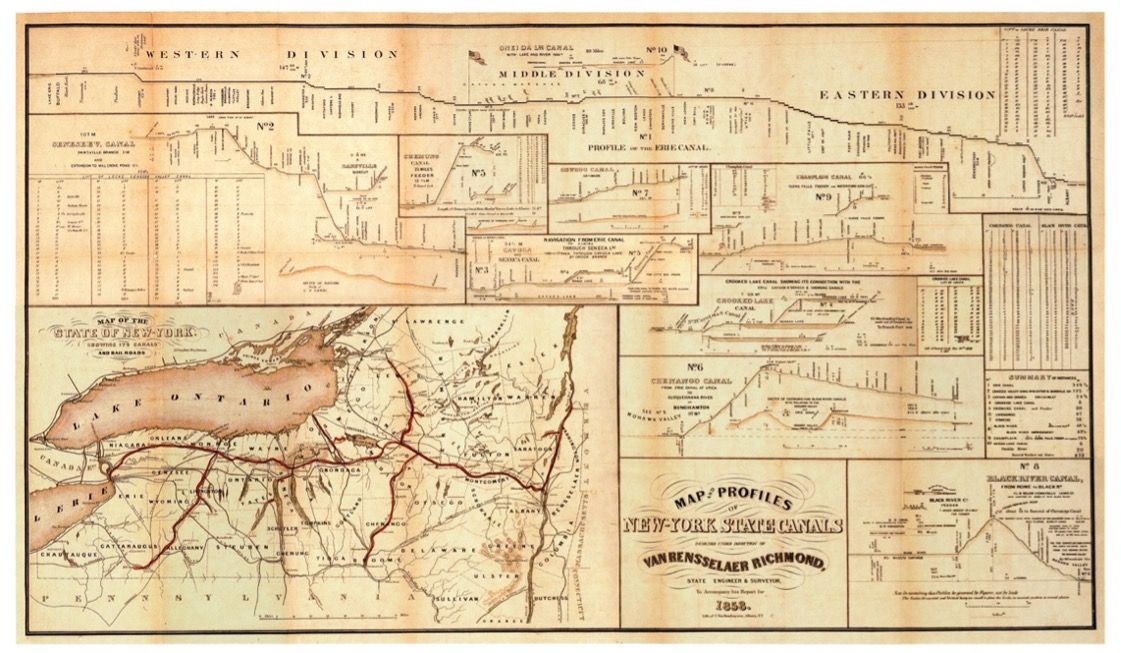
“Map and profiles of New-York State Canals --designed under direction of Van Rensselaer Richmond, State Engineer & Surveyor, to accompany his report for 1859,”Annual report of the New York State Engineer and Surveyor (C. Van Benthuysen, Albany, 1860) www.eriecanal.org/maps.html and https://www.eriecanal.org/maps/NYS-1858map.jpg