Martha
1853: Newspaper Accounts and Maps
Overview
With the help of Black waiters, Martha made a dramatic escape with her husband from Niagara Falls, New York, to Niagara Falls, Ontario, in August 1853. We know nothing of where she came from, how long she had been in Niagara Falls, or what happened to her after she and her husband reached freedom in Canada. All we know is what happened when she escaped.
It was August 1853. We can imagine that it was one of those days of clear air, sunshine, and
rainbows shining glory through the mist that brought visitors to Niagara Falls then and now. Martha, a young African American woman, stood talking with her husband in front of one of the main hotels, perhaps the Cataract House.
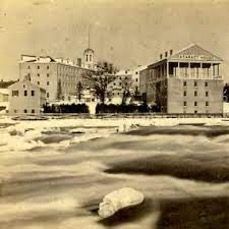
Cataract House, c. 1860
Courtesy National Park Service
A carriage drove up, and a white man got out. He looked at Martha, and she looked at him. Instantly, they recognized each other. The man had once owned Martha’s body, before she fled slavery. He greeted her with “How do you do, Martha?” and reached out to shake her hand. Martha would have none of it.
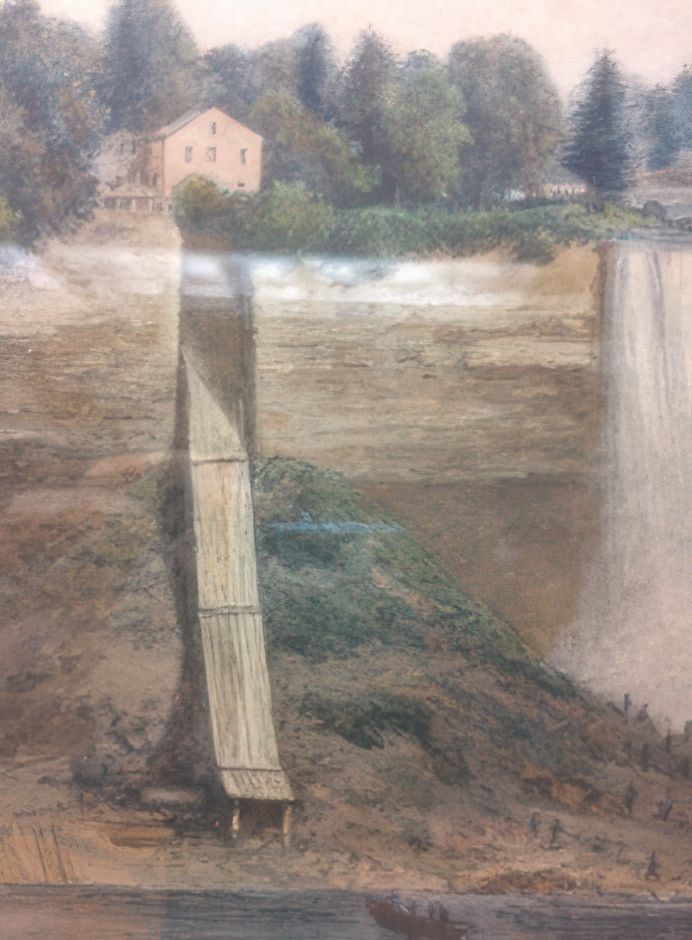
She backed off, turned, and ran as fast as she could toward the ferry dock at the base of the Falls, a short two blocks through Prospect Park. The Southerner bellowed that he would give a hundred dollars to anyone who caught her.
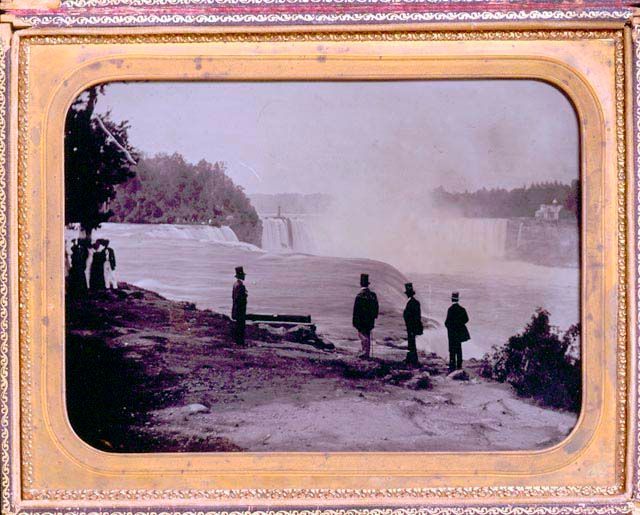
Platt Babbitt, Niagara Falls, c. 1854
Whole plate ambrotype. Courtesy Library of Congress
https://www.loc.gov/exhibits/treasures/tr22c.html#obj37
Several whites who favored slavery took up his challenge and began to chase her. But her husband ran quickly to her side, followed by hotel waiters, who placed themselves between Martha and her pursuers. She “outran them all, even the husband,” wrote one eyewitness, and “plunged down the ferry steps by hops instead of steps.”
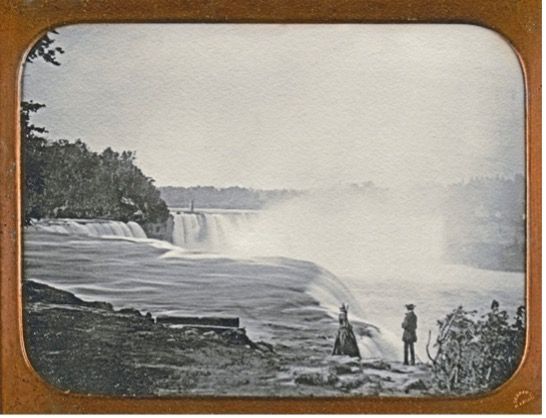
Boussod, Valadon, and Cie [after 1878]
Courtesy Wax Museum, Niagara Falls, New York3
The lone boat at the dock was too big for her to push off by herself. Instead, she leaped into it, followed by her husband, while her friends the waiters pushed it off with a handspike. Gliding just out of reach of those who chased her, Martha and her husband “sent up a glad and defiant hurrah,” loud enough to be heard through the roar of the Falls.
Afloat like an eggshell on the roiling river, they rowed through the dense mist. Fifteen minutes later, they reached the Canadian shore and docked just below the Clifton House. They were free!
Judith Wellman,
Sites Relating to the Underground Railroad, Abolitionism, and African American Life in Niagara Falls
(Appendix C, Heritage Area Management Plan, 2012, wwwniagarafallsundergroundrailroad.org), 1.
Newspaper Account
This story is based on an eyewitness account, reprinted widely in newspapers across the northeastern U.S. and Canada. Here the one that appeared in Frederick Douglass Paper, August 26, 1853, reprinted from the Cincinnati Christian Press. [1]
A RACE FOR LIBERTY. - A gentleman of our acquaintance related to us the following, which took place under his own eye at Niagara. He was standing on the steps of one of the principal hotels there, when a carriage drove up, containing a Southerner and his party. In front of the hotel stood a mulatto woman, talking with her husband while several colored waiters were also there employed in their various duties.[2] As the man stepped from the carriage, his eye met that of the woman, and on both sides there was instant recognition. He advanced toward her with the salutation, "how do you do Martha?" extending his hand. She shrunk back, fearing if she took the proffered and she would be detained by its grasp. He pressed toward her, while she retreated, and finally turned and run. The Southerner then howled out that he would give one hundred dollars to any one who would arrest her. Several were brutal enough to start like hounds in pursuit. But her husband sprang to her side, and the waiters interposed between them and the pursuers, and all rushed toward the river. The woman outran them, even the husband, and plunged down the ferry stairs by hops instead of steps. A single boat lay there, while she could not push it off. In a moment her friends were at her side again, while the pursuers were hurrying down the steps. She spring into the stern of the boat, followed by her husband, others seized a handspike and applied it to the boar, it moved, and as several hands were reached out to seize it, it glided just beyond them. An instant more and they were afloat on the broad river, and sent up a glad and defiant hurrah, that was heard above the roar of cataract. They reached in safety a soil which is truly free.
Surely our country presents a spectacle which should cause us all, but especially the Christian, to tremble. We boast that the oppressed from all lands may flow unto us and find rest and protection, while the unoffending citizens the native born of our own Republic, must seek their only safety in flight to a foreign shore. Fellow Christian, how far are you implicated in this system of outrage upon human rights? What are you doing to abolish it? How are you aiding to undo the heavy burden, and let the oppressed go free? Can our nation be safe while this dreadful wrong continues unrebuked by the churches? - Cincinnati Christian Press.
[1]This article appeared originally in the Cincinnati Christian Press (n.d.). It was re-published in the Weekly North American (Toronto), August 18, 1853; the Hamilton (Canada West) Gazette of August 18, 1853; the National Anti-Slavery Standard, August 20, 1853; the Norwalk, Ohio, Reflector on August 30, 1853; and Frederick Douglass Paper, August 26, 1853. Thanks to Christopher Densmore for helping to find these materials.
[2] This is an antiquated term taken from the Portuguese meaning “a person of mixed race.” It is used here in the context of an actually historical quotation, but is not acceptable terminology in either written or spoken English today.
Map
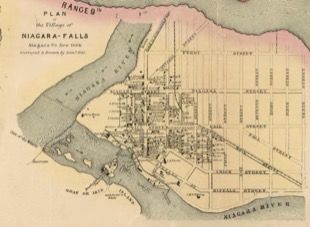
This map shows Niagara Falls in 1852, just a year before Martha’s escape, with the Cataract House, the International Hotel just north of it, the Ferry House, and the ferry crossing. Martha and her husband would have seen all of these places.
“Plan of the Village of Niagara-Falls,” from Map of Niagara County from actual surveys by F. Gifford and S. Geil, Civil Engineers (Philadelphia: Franklin Gifford, 1852). Courtesy Library of Congress.